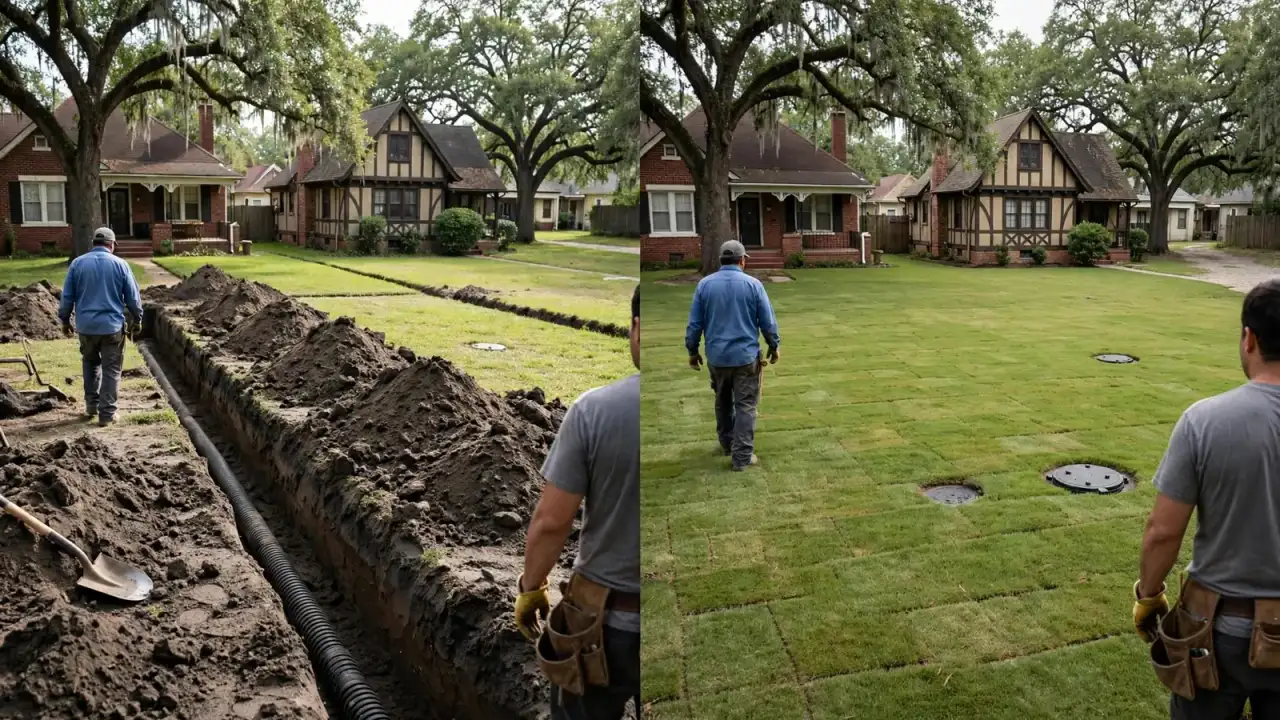
Key facts: Trenchless Sewer Repair
- Cured-in-place pipe lining installs a resin-saturated liner inside an existing pipe, which hardens to form a new pipe within the old one [1].
- Pipe bursting pulls a new pipe through the old one while a bursting head breaks the old pipe outward into the surrounding soil [2].
- Texas law requires a call to 811 before excavation so underground utilities can be marked [3].
- Sewer repairs and replacements in Dallas generally need a city plumbing permit and inspection [4].
How trenchless repair works
What trenchless sewer repair means
Trenchless is a family of methods that repair or replace buried pipe from the inside or from small access points, rather than digging the full length of the line. For residential sewer laterals, two methods are most common: cured-in-place pipe lining, often called CIPP or simply lining, and pipe bursting. [2] [1]
Lining creates a new pipe inside the old one. The line is cleaned thoroughly, often with a water jet and cutting tools to remove roots and scale. A flexible liner tube saturated with resin is pulled or inverted into the pipe, then inflated against the walls and cured with hot water, steam or ultraviolet light. Once hard, it forms a smooth, jointless pipe that seals cracks and root entry points. The plumber reopens any side connections with a cutter and films the finished line.
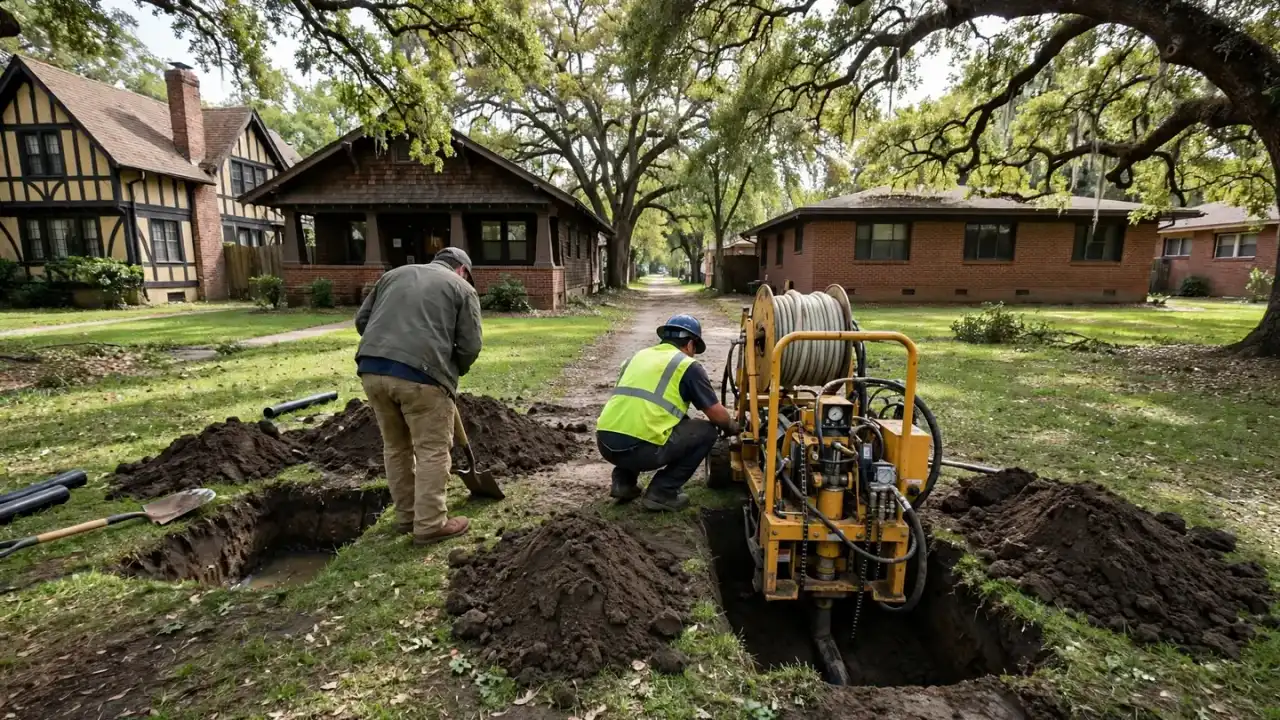
Pipe bursting replaces the pipe instead. A cable is threaded through the old line between two pits. A cone-shaped bursting head, attached to the new pipe, is pulled through, breaking the old pipe apart and pushing the fragments into the surrounding soil while the new pipe follows behind. The result is a new continuous pipe, usually high-density polyethylene, in the same path as the old one.
Both methods need access pits, typically one near the house and one near the connection to the city lateral, plus room for equipment. Neither fixes everything. A severely sagging line, a fully collapsed section or a pipe running under a slab may still need traditional excavation for part or all of the job.
Trenchless candidates
Signs a Dallas line may suit trenchless repair
Trenchless methods work best when the pipe's path is still usable.
Roots at many joints
Lining seals joints so roots cannot re-enter, once existing roots are cut out.
Read moreCracked but round pipe
Lining needs a pipe that still holds its shape.
Read moreLine under driveways, patios or trees
Avoiding excavation under hardscape and big trees is the main appeal.
Orangeburg or broken clay with a clear path
Pipe bursting can replace pipe that is too damaged to line.
Read moreLong laterals to alley sewers
Small pits beat a trench through fences, gardens and garages.
Repeat backups from a failing line
A camera confirms whether trenchless will solve the cause.
Read more
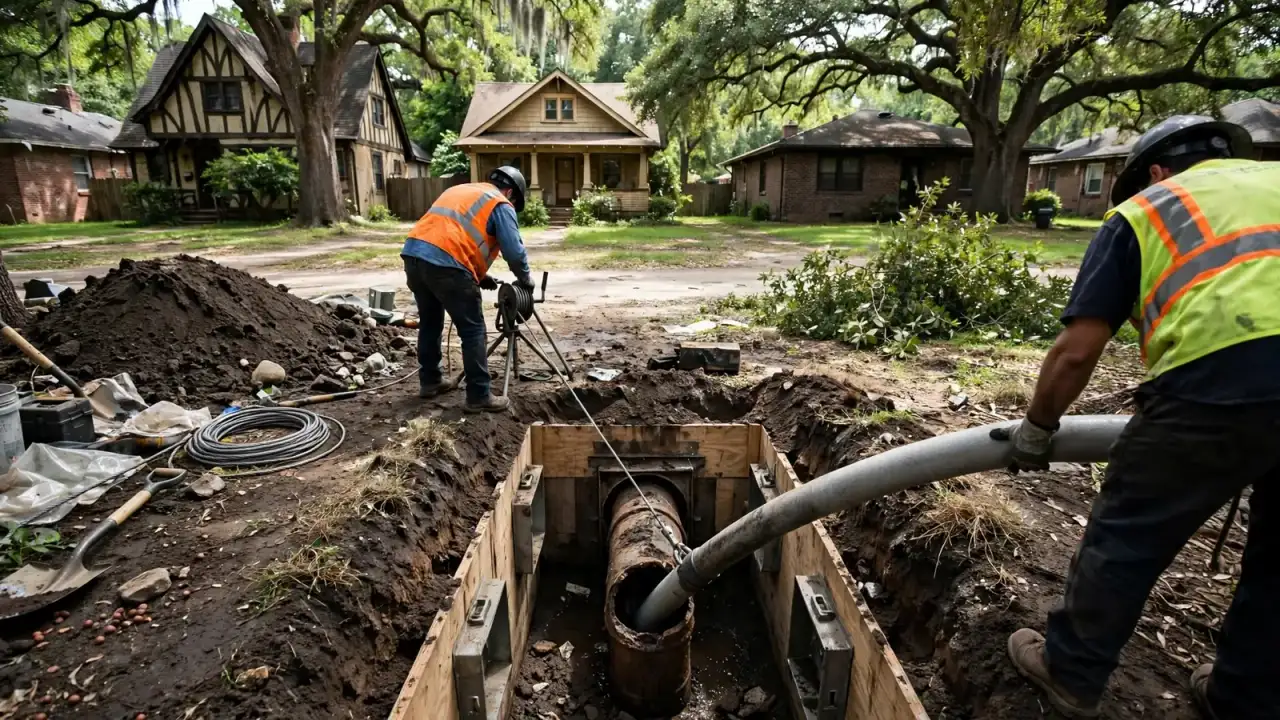
Liner figure
Why trenchless suits Dallas
Why trenchless methods appeal in Dallas
Dallas yards often contain exactly what homeowners do not want to dig up: mature live oaks and pecans with roots spreading over the sewer path, long driveways, pools, patios, fences and garages over alley-side laterals. A traditional trench means cutting through all of that, plus restoring landscaping and paving afterward.
Trenchless methods limit the disturbance to a couple of pits. For a lateral running under a forty-year-old live oak, that can be the difference between preserving and damaging the tree. For a line under a driveway, it avoids breaking and pouring concrete.
The city's clay is another factor. Pipe bursting replaces brittle clay or cast iron with flexible polyethylene, which tolerates ground movement better than rigid pipe with many joints. Lining removes joints altogether, closing the gaps that roots and soil movement exploit.
Trenchless steps
How a trenchless sewer repair is done
- 1
Inspect and locate
A camera inspection confirms the defects and maps the line's depth and path.
- 2
Permit and locates
The plumber pulls the Dallas plumbing permit and calls 811 to mark utilities. [3]
- 3
Dig access pits
Small pits are opened, usually near the house and near the city connection.
- 4
Prepare the pipe
For lining, roots and scale are cut out and the line is cleaned; for bursting, a cable is threaded through.
- 5
Install
The liner is inserted and cured, or the new pipe is pulled through with the bursting head.
- 6
Reconnect and test
Connections are made at each pit, the line is filmed and tested, and the city inspects where required.
- 7
Close up
Pits are backfilled and the surface is restored.
Trenchless methods compared
Lining and pipe bursting compared
| Factor | Pipe lining (CIPP) | Pipe bursting |
|---|---|---|
| What it does | New pipe formed inside the old one | New pipe pulled through as old pipe is broken out |
| Pipe needed | Old pipe must be intact enough to hold shape | Old pipe can be badly broken or Orangeburg |
| Diameter | Slightly reduced by liner thickness | Same or larger than original |
| Access | Often one or two pits or a cleanout | Usually two pits |
| Best for | Cracks, root entry, corroded but round pipe | Collapsed, deformed or brittle pipe |
| Not for | Bellies, collapsed sections | Lines with tight bends or nearby fragile utilities |
| Ground disturbance | Minimal | Minimal, with some ground movement near the pipe |
What you can do yourself
Preparing for a trenchless job
A few steps help the crew and protect your property.
- Mark sprinkler heads and irrigation lines near the expected pit locations.
- Move cars, planters and furniture away from the work areas.
- Keep pets inside while pits are open.
- Avoid using water during the time the line is out of service.
- Ask how long the house will be without sewer service.
- Keep the before and after videos with your house records.
Trenchless limits
When trenchless repair is not the answer
Lining follows the existing pipe exactly, so it cannot fix a belly. If water sits in a low spot today, it will sit in the liner too. Lining also needs a pipe that keeps its shape; collapsed sections must be excavated first. Pipe bursting needs space to pull the new pipe and can disturb nearby utilities if they cross too close. Lines with several sharp bends, mixed materials or very shallow depth can complicate both methods.
Under-slab drains are a special case. Lining can work inside the house if access exists, but many under-slab repairs still require tunneling or cutting the slab. A plumber will explain which applies after inspecting.
Trenchless sewer repair in Dallas: local specifics
Dallas conditions for trenchless work
In Dallas, the choice between trenchless and excavation often turns on three things: what the camera shows, what is above the line and where the line meets the city system. Alley-side connections in older neighborhoods mean pits may be needed in the alley or at the back fence. Street-side connections may need a pit in the parkway between sidewalk and curb.
The city requires a plumbing permit and inspection for sewer replacement work. Excavation, even for small pits, requires an 811 call so gas, electric, water and communication lines are marked. A licensed plumber handles both.
Clay soils are firm when dry and sticky when wet. After heavy rain, pits can fill with water and become unstable; in deep drought, the clay is hard and cracked. Crews plan around both.
Trenchless or dig
When trenchless repair makes sense
| Condition | Trenchless fits | Open trench fits |
|---|---|---|
| Cracks and roots, round pipe | Yes, lining | Possible but more disruptive |
| Collapsed or Orangeburg pipe | Pipe bursting | Yes |
| Bellies | No | Yes, re-lay with correct slope |
| Line under a big tree or driveway | Often preferred | Only if unavoidable |
| Very short line with easy access | Sometimes | Often simplest |
| Under-slab drains | Sometimes | Tunnel or slab cut often needed |
Related problems
Problems connected to trenchless repairs
Trenchless repairs often reveal related issues: missing cleanouts, poor connections at the city lateral, or interior drains in poor condition. Many plumbers recommend installing a two-way cleanout at the house end of the new line, making future inspections and clearing much easier.
If a repair addresses roots, consider the trees themselves. Roots will still seek moisture, but a lined or new seamless pipe gives them no way in.
Trenchless and trees
Protecting big Dallas trees during sewer repair
Large shade trees are one of Dallas's treasures, and many sewer laterals pass close to them. A trench through the root zone can cut major structural roots and harm the tree. Trenchless methods limit root damage to the pit locations, which can usually be placed outside the main root zone. If excavation near a significant tree is unavoidable, an arborist can advise on how to protect it.
After a trenchless repair
Caring for a lined or burst sewer line
After a trenchless repair, the line should be filmed to confirm the result. Keep the video. Avoid pouring grease down drains and flushing wipes, which can still cause clogs. If roots were the original problem, an occasional camera check every few years is a sensible, low-effort precaution over the following years confirms they have not found a new way in at connections.
Liner materials and curing
Liner types and how they cure
Liners come in different forms. Some are felt tubes saturated with resin on site; others use fiberglass reinforcement. Resins are typically epoxy or polyester-based. Curing can be done with hot water circulated through the liner, steam or ultraviolet light, depending on the system. Each approach has its own equipment and timing. What matters for a homeowner is that the plumber uses a system suited to the pipe size and length, follows the manufacturer's process and films the result.
Lateral liners are often installed from a cleanout or a small pit near the house, running toward the city connection. Where a lateral changes direction, liners can handle gentle bends but not sharp ones. The camera inspection identifies those bends ahead of time.
Bursting and the new pipe
What goes in with pipe bursting
With pipe bursting, the new pipe is usually high-density polyethylene, fused into one continuous length so there are no joints along the run. It is flexible enough to follow the old path and tolerant of some ground movement, a useful property in Dallas clay. At each end, the new pipe is connected to the existing building drain and to the city lateral with approved couplings.
Because bursting pushes the old pipe outward, the crew checks for nearby utilities and structures. Gas lines, water services or irrigation lines crossing close to the sewer may need to be exposed first so the bursting head does not damage them.
Trenchless and the city connection
Connecting a trenchless repair to the city lateral
At the far end of a lateral, the private building sewer meets the city's lateral near the property or easement line. Trenchless repairs generally stop at that connection. If the camera shows damage on the city side, the plumber will advise contacting Dallas Water Utilities, since the public side is the city's responsibility. A clean, well-sealed connection at the boundary is part of a good trenchless job.
Restoration after trenchless work
What the yard looks like afterward
With trenchless methods, restoration is limited to the pits. Soil is replaced and compacted, and sod or landscaping is patched. If a pit was in a driveway or walkway, a small section of concrete is replaced. Ask the plumber what restoration is included and what you will need to handle, such as reseeding grass. Compared with a full trench across a yard, the difference is usually dramatic.
Choosing a trenchless contractor
Questions to ask about a trenchless repair
Ask which method the plumber recommends and why, based on the camera video. Ask where the pits will go, how long the house will be without sewer service, what pipe or liner material will be installed and how connections at each end are made. Ask whether they will film the line afterward and provide the video, and who pulls the city permit. Check the plumber's license with the Texas State Board of Plumbing Examiners. [5]
Trenchless for multiple problems
When one line has several kinds of damage
Many older Dallas laterals have more than one problem: roots at several joints, a cracked section near the house and a belly midway. Trenchless and traditional methods can be combined. For example, the belly might be dug up and re-laid, and the remaining line lined. A camera inspection lets the plumber design the combination that fixes every defect with the least disturbance.
Weather and trenchless timing
How Dallas weather affects a trenchless job
Trenchless work can happen most of the year in Dallas, but weather still matters. Heavy spring rains can flood access pits and soften the clay, which may delay work or require pumping. Summer heat affects curing times for some liner systems, and installers adjust their process for temperature. In winter, occasional freezes can affect resin handling. A crew experienced in North Texas plans around these conditions.
Trenchless versus spot repair
When a small spot repair beats a full trenchless job
If the camera shows one defect in an otherwise healthy pipe, such as a single cracked joint near the house, a short excavation and spot repair may be the simplest and most direct fix. Trenchless methods shine when problems are spread along the line or when the line runs under things you do not want to dig up. The best choice depends on the full video, not on a preference for one technique.
Records after a trenchless job
Keeping records of a trenchless repair
Keep the before and after videos, the permit, the material type and the pit locations with your house records. If you sell the house, buyers will want to know the sewer was relined or replaced. If problems arise later, the records help the next plumber understand what was done.
Lateral size and trenchless
Pipe size and trenchless options in Dallas homes
Most Dallas house laterals are four-inch pipe, sometimes six-inch on larger homes or multi-unit buildings. Lining reduces the inside diameter slightly because of the liner's thickness, but the smooth interior usually carries flow as well as or better than the rough original. Pipe bursting can install the same size or upsize, which can help a duplex or a house with added bathrooms. The plumber chooses based on the fixtures served and the city connection.
Trenchless and old cleanouts
Adding cleanouts during trenchless work
Many older Dallas houses have no outdoor cleanout, or one that is broken or buried. A trenchless project is a natural time to add a two-way cleanout near the house, which allows camera access and clearing in both directions. The house-end access pit often becomes the location for it. Future service calls are faster and cleaner with good access.
Trenchless in tight alleys
Working from Dallas alleys
Alley access in older Dallas neighborhoods can be tight, with fences, garages, power poles and utility lines close to the sewer path. Crews size equipment to fit, plan pit locations around poles and other utilities and keep alleys passable for neighbors when possible. Ask how they will handle access if your connection is in the alley.
Trenchless and multi-unit buildings
Trenchless repair for Dallas duplexes and fourplexes
Small multi-unit buildings often share one larger lateral and carry heavier flow. Downtime matters more because several households lose service at once. Trenchless methods shorten the outage compared with a long trench and limit damage to shared yards and parking. Owners should plan the work for a weekday when tenants can be notified in advance, and ask the plumber whether temporary bypass arrangements are possible for longer jobs.
Trenchless after foundation repair
Trenchless repair after a Dallas foundation is leveled
Foundation leveling is common in Dallas, and it can shift or crack sewer lines near the house. If a post-leveling plumbing test or camera inspection finds damage, trenchless methods can sometimes repair the exterior portion without disturbing new piers or landscaping. Interior damage under the slab is assessed separately.
Trenchless questions
Questions about trenchless sewer repair in Dallas
Is trenchless sewer repair as durable as new pipe?
A properly installed liner or burst pipe forms a continuous new pipe. Durability depends on materials, installation quality and conditions, so ask the plumber what they expect for your line.
Can a liner fix a sagging sewer line?
No. A liner follows the existing pipe, so a belly remains a belly. Sags are usually fixed by excavating and re-laying that section.
How many holes will be dug for trenchless repair?
Usually one or two small pits, depending on the method and access. The camera inspection determines where they go.
Does trenchless work need a permit in Dallas?
Sewer repair and replacement generally require a city plumbing permit and inspection, whether trenchless or not.
Can roots grow through a liner?
A properly installed liner has no joints for roots to enter along its length. Connections at the ends must be sealed well.
Will pipe bursting damage my foundation?
The bursting head pushes old pipe outward into the soil near the pipe. Plumbers plan pit locations and depth to keep this away from foundations and other utilities.
How long is the house without sewer service?
Often part of a day to a day or more, depending on method and conditions. Ask the plumber for a realistic timeline on the call, including the city inspection.
Is trenchless repair possible on an alley sewer?
Often yes. Pits may be placed near the house and in or beside the alley. Fences, garages and utilities in the alley affect where the pits can go.
Do tree roots matter for pipe bursting?
Large roots crossing the pipe path can resist the bursting head. The camera and locator help identify them, and some may need to be exposed first.
Can trenchless be used under my slab?
Sometimes, if access allows lining from inside. Many under-slab repairs still need tunneling or slab cuts.
What should I tell the plumber about a possible trenchless repair?
Share any camera video, where the line runs, what sits above it such as trees, driveways or patios, and whether your connection is in the alley or out at the street.