Key facts: Sewer Camera Inspection
- Plumbing work in Texas, including diagnosing and repairing building sewers, is regulated by the Texas State Board of Plumbing Examiners [1].
- Vitrified clay and cast iron, both common in older Dallas laterals, are prone to joint failure and cracking as they age [2].
- Under the Dallas City Code, the owner's plumber builds the building sewer from the house drain to the city's lateral near the property line [3].
- Much of Dallas sits on Houston Black clay, which shrinks and swells strongly with changes in moisture [4].
How a camera inspection works
What happens during a sewer camera inspection
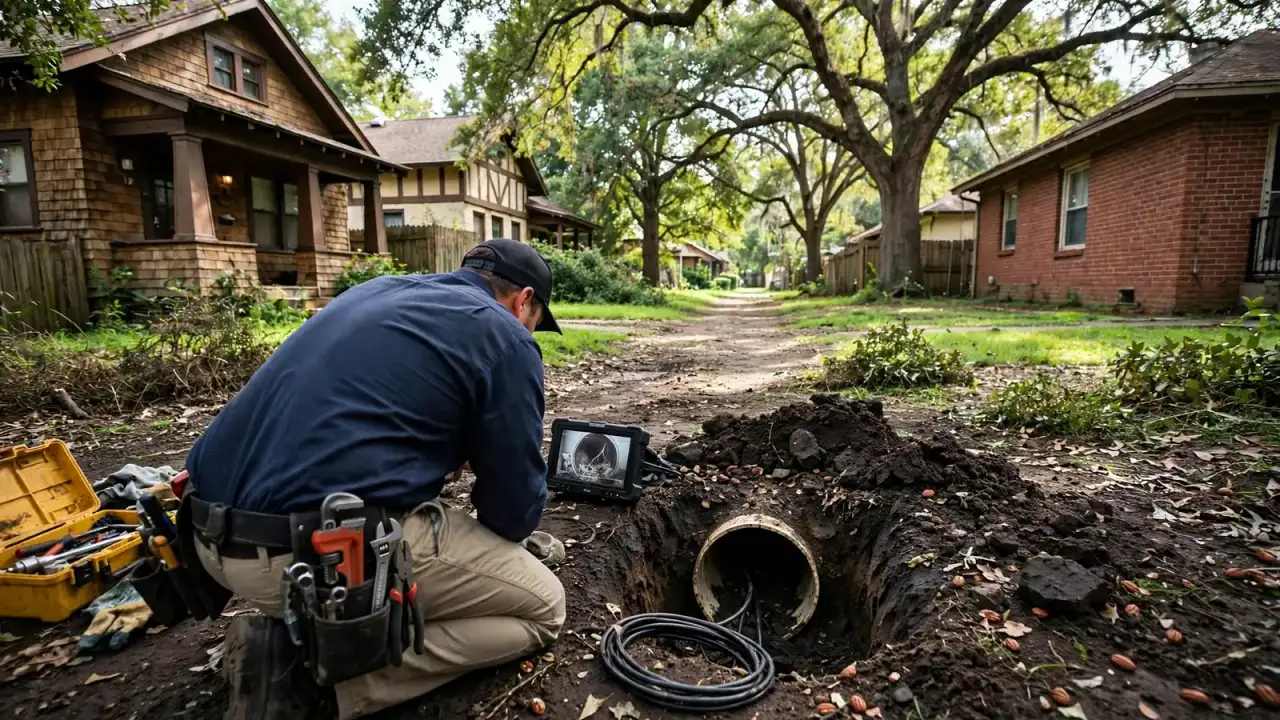
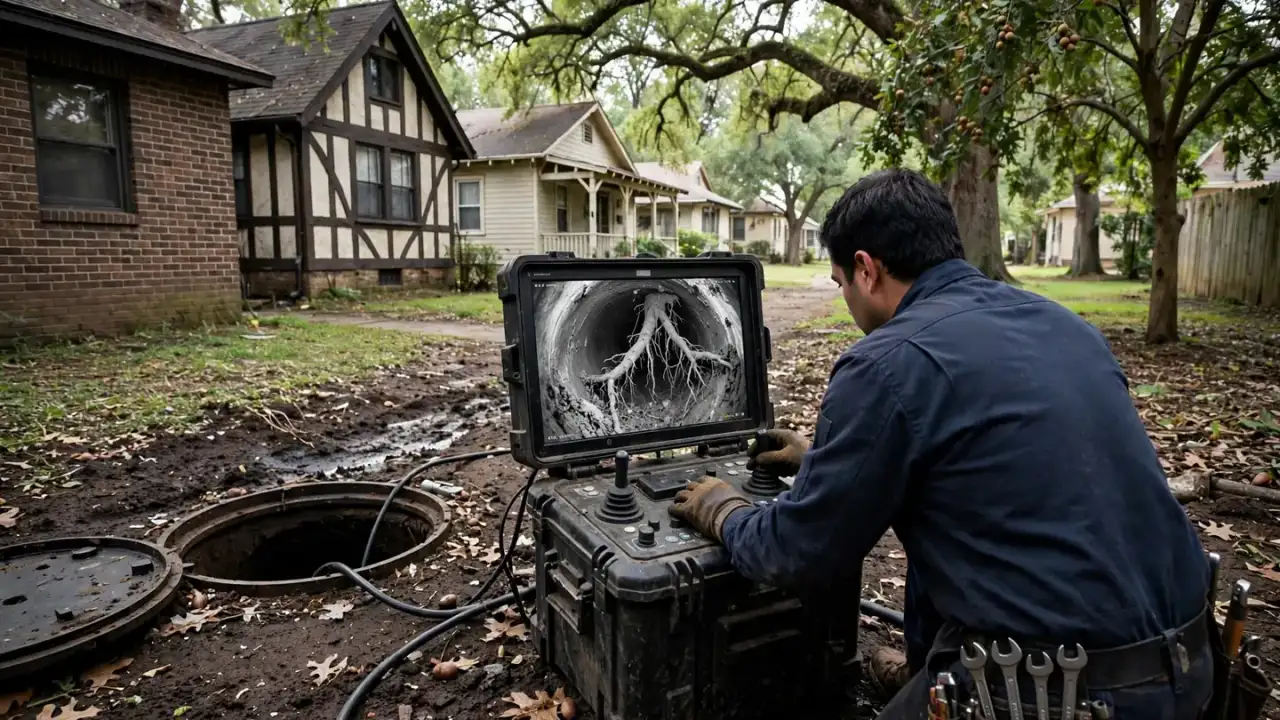
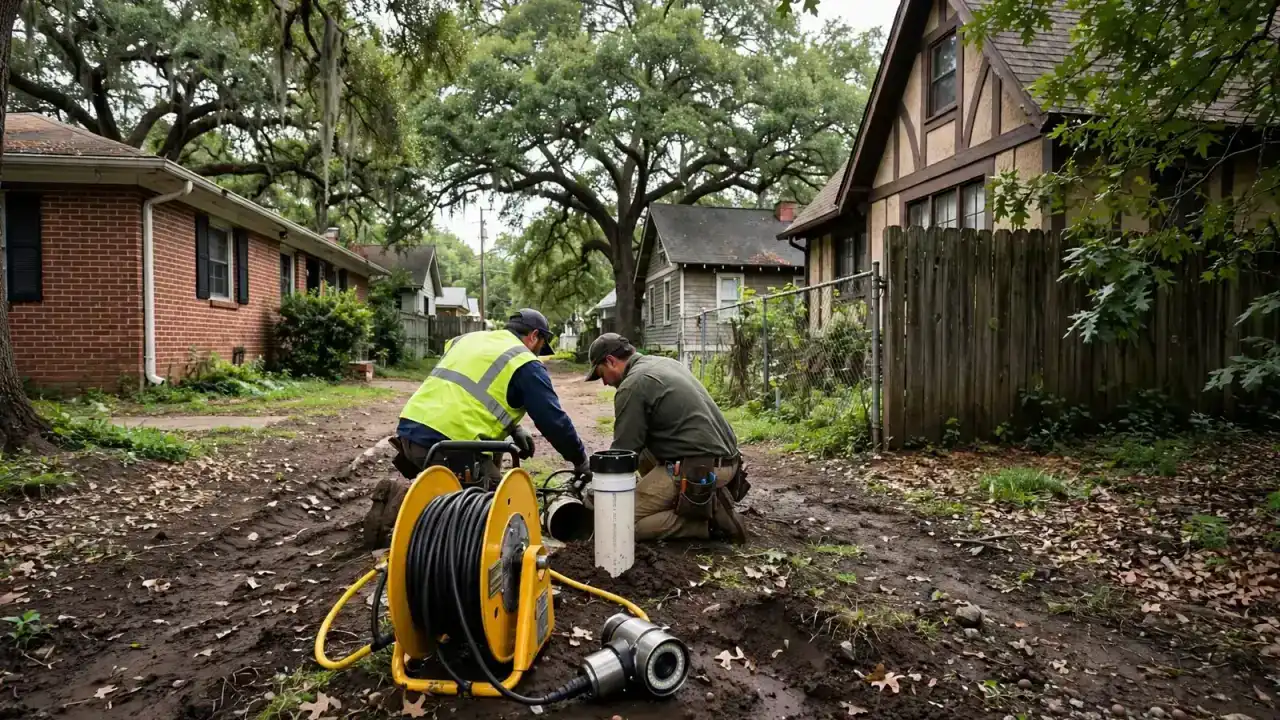
A sewer camera is a small waterproof camera head with its own lights, mounted on a stiff but flexible push cable that coils on a reel. The plumber feeds the head into the sewer through a cleanout, a roof vent or, if there is no other access, a toilet flange with the toilet pulled. As the cable is pushed, the camera sends live video to a monitor and records it, along with a running count of how many feet of cable are in the pipe.
Most residential laterals in Dallas run somewhere between a few dozen and more than a hundred feet from the house to the city's connection, depending on lot size and where the main sits. Houses with alley sewers, common in older East Dallas and North Oak Cliff neighborhoods, often have the connection at the back of the lot. Houses with street sewers connect in the front. The camera follows the pipe until it reaches the city main, a blockage it cannot pass or the end of its cable.
Many camera heads contain a small radio transmitter called a sonde. Above ground, the plumber uses a handheld locator to find the signal and mark the exact spot of any defect on the lawn, along with an estimate of its depth. That combination of video, footage count and surface mark is what makes a camera inspection so valuable: it tells you not just that there is a problem, but exactly where to dig, or whether digging is needed at all.
A good inspection ends with a conversation. The plumber should play back the key moments of the video, explain what each defect means and describe the realistic repair options. Many will give you the recording so you can keep it or show it to someone else before deciding.
When to get a camera inspection
Signs a Dallas sewer line needs a camera inspection
A camera is worth it any time the problem may be in the main line rather than one fixture.
More than one drain backs up
When a toilet bubbles while the washer drains, or a tub fills when the toilet flushes, the blockage is usually in the shared line.
Read moreClogs that keep coming back
A line that needs clearing every few months almost always has roots, a belly or a break that a camera will show.
Read moreSewage smell or soggy yard
Smells outside or a wet patch over the line point to a leak that needs locating.
Read moreBefore buying an older home
A camera inspection is one of the best checks you can arrange on a pre-1980 Dallas house.
After foundation repair
Leveling a slab or pier-and-beam house can shift drain lines; checking afterward catches damage early.
Before a remodel
Adding a bathroom or moving fixtures is the time to confirm the main can handle it.
Camera kit figure
What the camera finds
What a camera usually finds in Dallas sewer lines
Roots are the most common finding in older Dallas neighborhoods. They show up as fine hair-like strands at joints, dense mats that fill the pipe, or a single thick root that has pushed through a crack. Live oaks, pecans, elms and hackberries planted decades ago now have root systems that reach across front and back yards, and they are drawn to the moisture escaping from sewer joints.
Offsets are next. In clay and cast iron lines, the joints between sections can shift as the ground moves, so one section ends up higher or to the side of the next. On video this looks like a ledge or a step. Small offsets catch paper and grease. Larger ones become blockages and let water and roots in.
Bellies, or sags, are low spots where a section of pipe has settled. Water sits in the low area, and solids settle with it. On camera, the lens goes underwater or the plumber sees a long pool. In Dallas clay, which swells and shrinks with moisture, bellies are common in long laterals.
Cracks and breaks range from hairline fractures to missing pieces of pipe. Cast iron under slabs often shows heavy scale and corrosion, with the bottom of the pipe worn thin or rotted through. Orangeburg pipe, found in some homes built before the 1970s, deforms into an oval and eventually collapses.
Finally, the camera finds connection problems: a building sewer that meets the city lateral at a poor angle, a missing cleanout, or old repairs made with mismatched materials.
Inspection step by step
How a plumber runs a sewer camera inspection
- 1
Find access
The plumber locates a cleanout outside or inside, or arranges access through a vent or toilet.
- 2
Clear if needed
If sewage is backed up, the line is often cleared first so the camera can see.
- 3
Run the camera
The camera goes in slowly, recording the pipe and noting the distance of each defect.
- 4
Locate from above
At key points, the plumber finds the sonde signal and marks position and depth on the ground.
- 5
Review the video
Together you look at what the camera saw and what each defect means.
- 6
Discuss options
The plumber explains which repairs fit what was found, from cleaning to replacement.
Camera findings
What common camera findings mean
| Finding | What it looks like | Usual next step |
|---|---|---|
| Fine roots at joints | Hair-like strands at regular intervals | Cutting and root control, then re-inspection |
| Heavy root mass | Pipe filled with a mat of roots | Cutting, then repair or lining of the entry points |
| Offset joint | A step or ledge between sections | Spot repair or lining if minor |
| Belly | Standing water, lens goes under | Excavate and re-lay that section |
| Crack or fracture | Visible lines, missing pieces | Lining, spot repair or replacement |
| Corroded cast iron | Scale, rough walls, thin or missing bottom | Lining if structure remains, otherwise replacement |
| Deformed Orangeburg | Oval or flattened pipe, blisters | Replacement |
What you can do yourself
Things homeowners can do before an inspection
These steps help the plumber and keep the house safe in the meantime.
- Find your cleanout: usually a capped pipe a few inches across near the foundation or close to the property line.
- Note which fixtures back up and in what order; the lowest fixture usually overflows first.
- If sewage is backing up, stop running water until a plumber clears the line.
- Note the locations of large trees, sprinkler lines and any past repairs in the yard.
- Gather any old inspection videos or reports, especially from a home purchase.
- Do not pour chemical drain cleaners into a backed-up main; they rarely clear it and make work dangerous.
Where to stop
When homeowners should leave it to the plumber
Opening a cleanout with sewage backed up behind it can release a surge of waste, so it is best left to the plumber. Rental camera kits are available, but interpreting what they show and locating the defect accurately takes practice. More important, a camera often runs right up to the city's lateral, and understanding where private responsibility ends is part of the plumber's job.
If the camera can't pass a blockage, the plumber may need to clear the line first with a cable machine or water jet, then return with the camera.
Sewer camera inspection in Dallas: local specifics
Dallas factors that shape a sewer inspection
Dallas has a few features that make camera inspections especially useful. The first is soil. Large parts of the city sit on dark, heavy Blackland Prairie clay that swells when wet and shrinks during droughts. [4] Over years, that movement shifts pipe joints, creates bellies and cracks rigid pipe. A camera shows how much movement has occurred along the line.
The second is age. Neighborhoods such as Lakewood, the M Streets, Kessler Park and parts of Oak Cliff have houses from the 1920s through the 1940s, many still with clay or cast iron laterals. Post-war areas like Casa View and Lake Highlands have cast iron drains under slab foundations. Each era has its typical failure points.
The third is layout. Many older Dallas neighborhoods have alley sewers, so the lateral runs to the back of the lot, sometimes under garages, fences and patios. Others connect to a main under the street in front. The camera's footage count and locator tell you which way the line runs, which matters before planning any repair.
Finally, responsibility. Under the Dallas City Code, the property owner's plumber installs and maintains the building sewer from the house to the city's lateral near the property or easement line. [3] A camera inspection often shows where that connection is and whether the problem lies on the private side.
Repair or replace after the camera
Using the video to choose a repair
| Video shows | Often repairable by | When replacement is likely |
|---|---|---|
| One defect in an otherwise good pipe | Spot repair | Rarely |
| Roots at several joints, pipe round and intact | Cleaning plus lining | If roots return after lining is ruled out |
| Many cracks, pipe still holds its shape | Lining | If the pipe is deformed |
| Bellies along the line | Partial excavation | If bellies are widespread |
| Collapsed or Orangeburg pipe | Not repairable | Pipe bursting or open-trench replacement |
Related problems
Problems that often show up with camera findings
Camera findings often explain other symptoms in the house. A belly in the lateral can cause gurgling in toilets and slow drains everywhere. A root-filled joint can explain a smell in the yard after rain. Corroded cast iron under a slab can be connected to damp flooring, odors or even foundation movement as leaking water saturates the clay. Mention all of these on the call so the plumber knows to look for links.
Grease buildup and wipes are common non-structural findings. They are cleared with cabling or jetting, and avoiding them in the future keeps the line clear.
Inspections when buying a home
Camera inspections before buying a Dallas house
Standard home inspections usually do not include a sewer camera. For older Dallas homes, many buyers add one. A pre-purchase camera inspection can reveal clay pipe full of roots, cast iron with corroded bottoms or a belly under the driveway, all of which are much better found before closing. Ask the seller whether they have a recent video, and if not, arrange access to a cleanout for the inspection.
Inspections after foundation work
Checking sewer lines after foundation repair
Foundation repair is common in Dallas because of the expansive clay. Leveling a house with piers can shift drain lines under and around it, especially cast iron under slabs. Many foundation contractors recommend a plumbing test before and after the work. A camera inspection after leveling can show whether joints separated or pipe cracked during the lift.
Hydrostatic testing
Camera inspections and plumbing pressure tests
For drain lines under a slab, a plumber may combine a camera inspection with a hydrostatic test. The drains are plugged, filled with water and watched for drops in level that indicate a leak. The camera then helps find the location. This combination is useful when you suspect a leak under the house but do not see an obvious backup.
Reading the footage counter
How distance on the video maps to your yard
Every camera inspection records distance. The counter on the screen shows how many feet of cable are in the pipe, measured from where the camera entered. If the camera went in at a cleanout beside the foundation and the counter reads forty-two feet at a root mass, the problem is roughly forty-two feet along the pipe's path, which may curve. That is why the locator matters: it finds the camera head through the soil and marks the spot directly above it, along with its depth.
In practice, plumbers combine both. The counter tells them where to stop, and the locator tells them where to mark. On a Dallas lot with an alley sewer, the marks might run from the back of the house, under a patio and across the yard to the fence. On a lot with a street sewer, they run toward the front yard and parkway. Those marks, painted or flagged on the ground, become the plan for any repair.
Depth and the clay
How deep Dallas sewer laterals usually run
Residential laterals are typically a few feet deep near the house and get deeper toward the city main, because the pipe must slope downhill at a steady grade. In parts of Dallas with rolling terrain, such as Kessler Park and parts of Oak Cliff and Lake Highlands, depth can vary more along the line. The locator's depth reading helps plan excavation, choose pit locations for trenchless work and decide whether trees or structures are close enough to matter.
Depth also affects how much the clay moves the pipe. Shallow sections near the house sit in the zone where seasonal wetting and drying is strongest, which is one reason offsets and cracks often cluster near foundations.
Inspection versus clearing
Why clearing a line is not the same as fixing it
Many sewer calls start with a backup, and the first step is often clearing the line with a cable machine or water jet. That restores flow, but it does not tell you why the line blocked. Roots grow back. Bellies collect solids again. Broken sections keep letting soil in. A camera inspection after clearing shows whether the backup was a one-time clog or a sign of a structural problem that will keep returning.
If a line needs clearing more than once a year, the camera inspection is almost always worth it. It turns recurring service calls into a plan.
Camera inspections for older cast iron
Inspecting cast iron drains under Dallas slabs
Houses built on slabs from the 1950s through the 1970s, common in Lake Highlands, Casa View and other post-war neighborhoods, usually have cast iron drains running under the floor. Over decades, cast iron scales and corrodes from the inside, and the bottom of the pipe can wear thin or open up. A camera shows the condition of those lines, though access may require a cleanout inside the house or removing a toilet. Findings under the slab often lead to discussions of lining, rerouting the drain through the attic or walls, or tunneling.
Camera inspections and city problems
When the camera points to the city's side
Sometimes the camera travels the whole private line without finding a defect, then reaches the city connection and finds the blockage there, or finds the main itself surcharged with standing water. In that case the problem belongs to the public system. The plumber can note the distance and show you the video so you can report it to Dallas Water Utilities through the city's service request channels. Having a video makes those conversations clearer.
Camera inspections for rentals and duplexes
Inspections on Dallas duplexes and rental homes
Older Dallas neighborhoods include many duplexes and small rental buildings, especially near Lower Greenville, the M Streets and parts of Oak Cliff. Two or more units sharing one lateral means more water, more grease and more wipes, and backups affect several households at once. Owners of these buildings often schedule periodic camera inspections to catch roots and buildup before tenants experience a backup.
Camera inspection questions
Questions about sewer camera inspections in Dallas
How long does a sewer camera inspection take?
Many inspections take an hour or two, including finding access, running the camera and locating defects. Clearing a blockage first or tracing a long line can add time.
Do I need a cleanout for a camera inspection?
A cleanout makes it easier, but plumbers can also enter through a roof vent or a toilet flange. Adding a cleanout is often recommended during repairs.
Can the camera see the city's part of the sewer?
It can usually reach the connection with the city lateral and sometimes into the main. Problems on the public side are reported to the city rather than repaired by your plumber.
Will a camera show tree roots?
Yes. Roots show clearly on video, from fine strands at joints to dense mats filling the pipe.
Should I get a camera inspection before buying an older Dallas home?
It is a common and worthwhile step for older homes, because sewer defects are hidden from a standard inspection.
Can I keep the video?
Many plumbers provide the recording. Ask on the call whether it will be included.
What if the camera can't get past the blockage?
The plumber usually clears the line with a cable machine or water jet, then runs the camera again.
Does a camera inspection need a permit in Dallas?
An inspection by itself does not involve construction. Repairs that follow, such as replacing pipe, generally need a city plumbing permit.
How often should an older Dallas sewer line be inspected?
There is no fixed rule. Lines with a history of roots or backups are often checked every year or two; lines in good condition may only need checking when symptoms appear or before a home sale.
Can a camera find a leak under my slab?
It can show cracks and corrosion in drains under a slab. Pairing it with a water test helps confirm an active leak and its location.
What should I tell the plumber when I call about an inspection?
Which fixtures back up and when, the age of the house, whether there is a cleanout, where large trees stand and any past sewer work.