
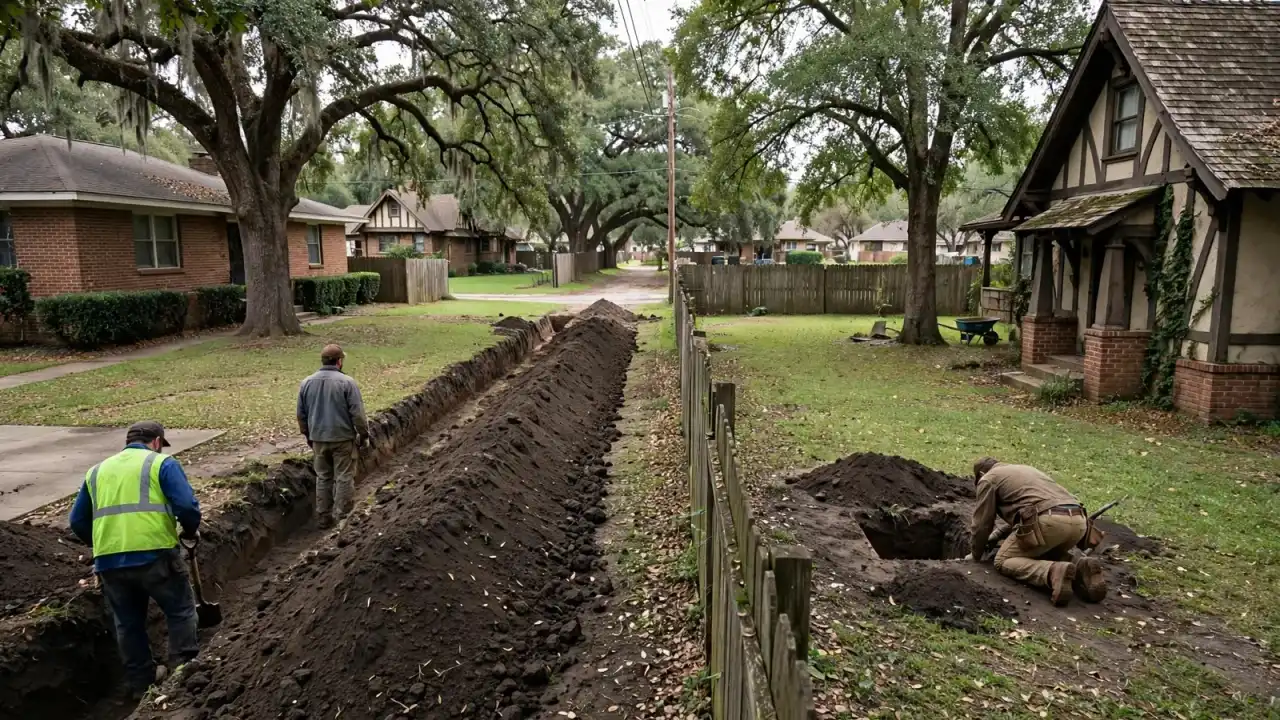
Key facts: Trenchless vs excavation
Trenchless or dig: the short answer
Trenchless or excavation: the short answer
Trenchless suits lines that keep their shape and path, especially under trees, driveways or patios. Excavation suits bellies, collapsed sections, shallow lines with easy access and spot repairs. Many jobs combine both.
Method comparison
Trenchless and excavation compared
| Factor | Trenchless | Excavation |
|---|---|---|
| Yard disturbance | Small pits | Trench along the line |
| Fixes bellies | No | Yes |
| Collapsed pipe | Bursting may work | Yes |
| Under trees and hardscape | Strong fit | Disruptive |
| Spot repair | Less suited | Strong fit |
Staging figure
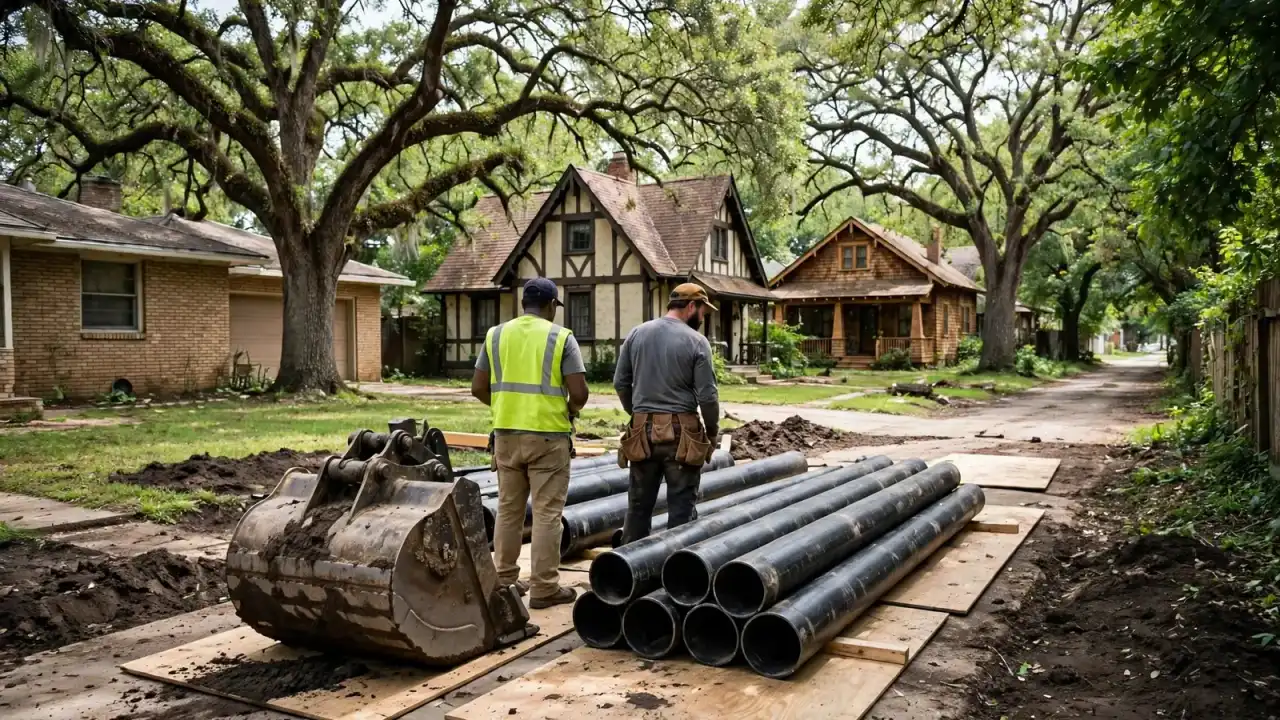
Questions to answer first
Questions to answer before choosing
- What does the camera show along the whole line?
- Are there bellies?
- What sits above the line?
- Is the connection in the alley or the street?
- How deep is the pipe?
When trenchless wins
When trenchless is the better choice
Trenchless wins when the pipe is round and continuous but cracked or root-infested, when it runs under trees, driveways or patios, and when the line is long.
When digging wins
When excavation is the better choice
Digging wins for bellies, collapsed sections, short shallow runs and single defects that a small hole can reach.
Dallas yards
How Dallas yards shape the choice
Mature trees, long driveways, pools and alley-side laterals in older Dallas neighborhoods often tip the balance toward trenchless. Shallow front-yard lines with open lawn may be simpler to dig.
How plumbers decide
How plumbers decide between methods
- 1
Camera inspection
Map defects and path.
- 2
Locate
Find depth and position.
- 3
Survey above
Trees, paving and structures.
- 4
Recommend
Choose one method or a combination.
Combining methods
Combining trenchless and excavation
Many lines need both: dig to fix a belly, then line the rest. The camera video makes this plan possible.
Trees and method choice
How big trees tip the decision
Many Dallas laterals run under or near large trees. A trench through the root zone can sever major roots and harm the tree. Trenchless methods place small pits outside the critical root zone when possible. If excavation near a tree is unavoidable, an arborist can advise on protecting it. For homeowners who value their trees, this often decides the method.
Hardscape and method choice
Driveways, patios and pools
Saw-cutting and replacing a driveway or patio adds work and disruption to an excavation job. Trenchless methods avoid most of it. On the other hand, if the line is shallow and runs through open lawn, a trench may be quick and straightforward.
Depth and slope
Depth, slope and the method choice
Deep lines require bigger trenches with shoring for safety, which favors trenchless. Lines with bellies need re-laying at the correct slope, which requires excavation of those sections. The locator's depth readings and the camera's footage help plan both.
Restoration differences
What each method leaves behind
After excavation, the trench is backfilled and the surface restored, and clay may settle for months. After trenchless work, only the pits need restoring. For many owners, the restoration difference is the deciding factor.
Alley connections and method choice
Alley-side sewers and the method choice
Older Dallas neighborhoods often have sewer mains in alleys. Laterals there run under back yards, garages and fences. Excavation means working around those structures and in the alley; trenchless methods may need just one pit near the house and another at the alley. Utility poles, gas lines and neighbors' access in the alley also shape the plan.
Permits and inspections for each method
Permits for trenchless and excavation in Dallas
Both methods generally need a City of Dallas plumbing permit and inspection. Both require an 811 call before digging. [3] Trenchless jobs still dig pits, so locates apply. Ask the plumber who handles each step and how the inspection is scheduled.
Time without service
Downtime with each method
Sewer service is off while the line is cut and reconnected. Trenchless lining or bursting often limits that to part of a day. Long excavations can take longer, especially if inspection must happen before backfilling. Ask for a realistic estimate of downtime.
Long-term results
Long-term results of each method
A properly installed liner, burst pipe or new trenched pipe all give a continuous modern line. The difference is how they deal with the old line's path. Liners and burst pipe follow it; trenched pipe can correct grade and route. If the original path had slope problems, excavation offers the more complete fix.
Questions for the plumber
Questions to ask when comparing methods
Ask why the plumber recommends one method over the other for your line, where pits or trenches will go, how long sewer service will be off, what restoration is included and whether the finished line will be filmed. A good answer refers back to the camera video.
Utilities in the way
Gas, water and cable lines near the sewer
Dallas yards contain gas services, water lines, irrigation, cable and electric lines. The 811 call marks utility-owned lines, but private lines such as irrigation and low-voltage lighting are not marked. Crews dig carefully near marks, and pipe bursting requires checking that nothing fragile crosses close to the sewer path. [2] Point out any private lines you know about.
Preparing for either method
Preparing for either method
- Flag sprinklers and lighting.
- Move vehicles.
- Plan for time without sewer service.
Method questions
Questions about trenchless versus excavation
Is trenchless always better?
No. It cannot fix bellies, and some lines are simpler to dig.
Does excavation fix more problems?
It can address slope and collapse directly, at the expense of more disturbance.
Which method protects trees?
Trenchless usually disturbs fewer roots.
Do both need permits in Dallas?
Sewer repairs and replacements generally need a city plumbing permit either way.
Can trenchless and excavation be combined on one line?
Yes. A common plan is to dig out a belly and line the rest of the pipe.
Do I need to be home during the work?
Usually for the start and the final review. Crews need access to the cleanout and sometimes inside the house.
What happens to the old pipe with pipe bursting?
It is broken into pieces and pushed into the surrounding soil, where it stays.
Is trenchless repair possible for every Dallas home?
No. Collapsed lines, bellies, sharp bends and some under-slab drains limit it. The camera inspection shows whether it fits.
Will excavation damage my lawn permanently?
Usually not. Lawns recover after backfill and reseeding, though clay may settle and need topping up.
Which method is faster?
It depends on the line. Trenchless often reduces restoration time; excavation may be quick for short, shallow lines.
How do I know which my line needs?
A camera inspection and the plumber's assessment decide it.