Key facts: Sewer Line Replacement
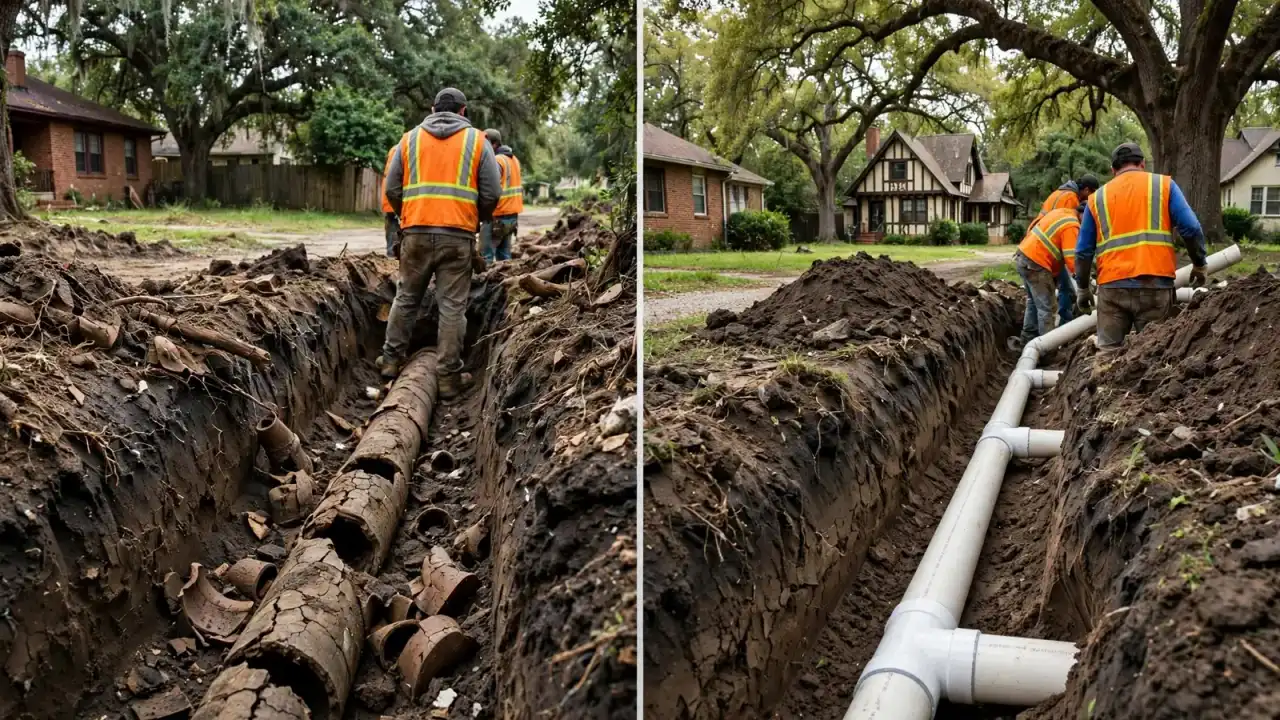
- Orangeburg pipe, made from wood fiber and pitch, was used for sewer laterals until the 1970s and tends to deform and collapse with age [1].
- Cast iron drains corrode from the inside over decades, which can leave the bottom of the pipe thin or open [2].
- Sewer line replacement in Dallas generally requires a city plumbing permit and inspection before the trench is backfilled [3].
- Texas law requires calling 811 before digging so buried utility lines are located and marked [4].
How replacement works
What full sewer line replacement involves
Replacing a sewer lateral means removing or abandoning the old pipe between the house and the city's connection and installing a continuous new one. The new line must slope steadily downhill so waste flows by gravity, sit on proper bedding so it does not sag, connect cleanly to the house drain and to the city lateral, and include cleanouts so it can be inspected and cleared later.
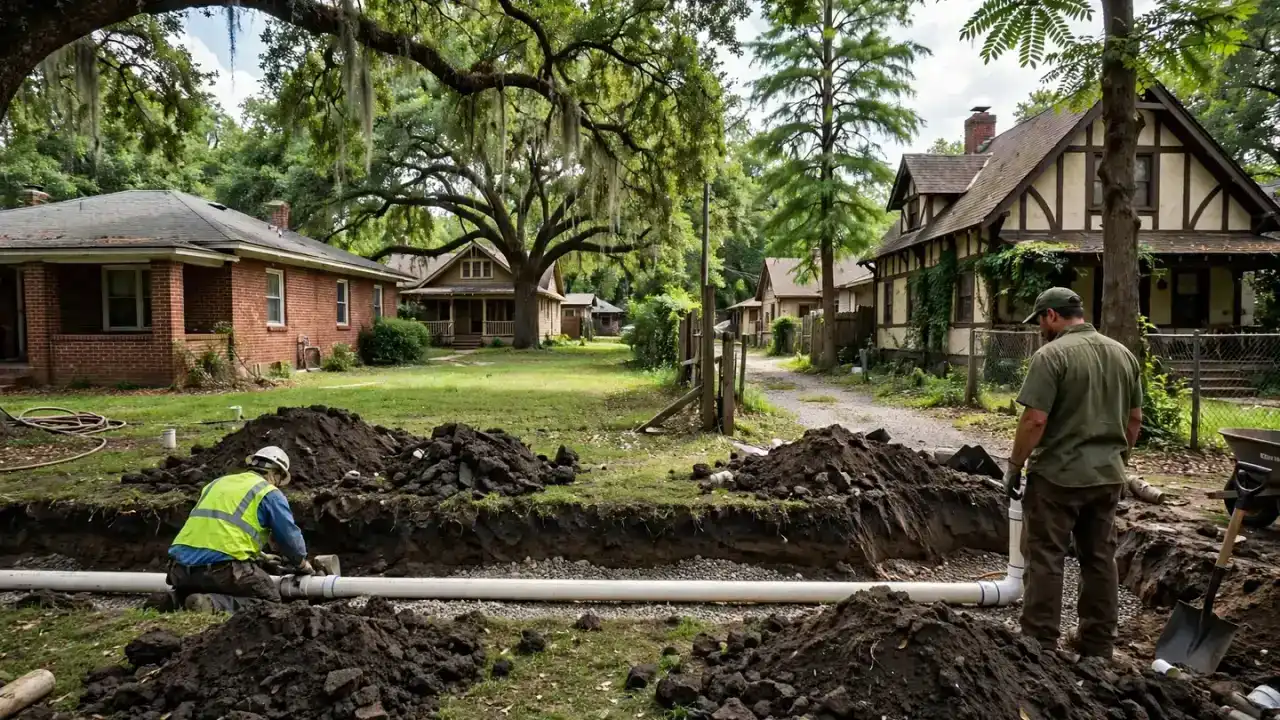
There are two main ways to do it. In an open-trench replacement, a crew digs along the line's path, removes the old pipe, prepares a bed of sand or gravel, lays new pipe at the correct slope, has it inspected, then backfills and compacts the trench. In pipe bursting, a crew digs a pit at each end and pulls new pipe through the old path while breaking out the old pipe. Both give you a new lateral; they differ in how much of the yard is disturbed and which situations they suit.
Most new laterals in Dallas use PVC with solvent-welded joints or high-density polyethylene with fused joints. Both resist roots and corrosion far better than clay, cast iron or Orangeburg. [1] The installer follows the plumbing code for slope, cleanouts, bedding and connections, and the city inspects before the trench is closed.
When replacement is needed
Signs a Dallas sewer line needs replacing
These findings usually mean repair is no longer the sensible option.
Orangeburg pipe
Fiber pipe that has turned oval or collapsed cannot be lined or patched reliably.
Read moreRepeated breaks along the line
When several sections are cracked or offset, piecemeal repairs keep chasing the next failure.
Read moreBellies in many places
Sags spread along the line need the pipe re-laid at the correct slope.
Heavily corroded cast iron
Pipe with missing bottoms or crumbling walls cannot support a liner.
Roots through many joints of clay pipe
Old clay with roots everywhere may be better replaced than cleaned forever.
Read moreLine too small or poorly routed
Additions and new bathrooms can outgrow the original line.
Slope check figure
Why laterals fail
Why Dallas sewer laterals reach the end of their life
Dallas has seen several eras of sewer materials. Homes from the 1920s through the 1940s often have vitrified clay laterals with short sections and many joints. Those joints were sealed with mortar or early gaskets that have long since failed, inviting roots and letting sections shift. Mid-century homes sometimes used Orangeburg, a fiber pipe that softens and deforms over time. Many homes from the 1950s through the 1970s used cast iron, especially under slabs, which corrodes from the inside.
The ground adds stress. Blackland Prairie clay swells after rain and shrinks in drought, sometimes dramatically during long Texas summers. That movement pushes, pulls and bends buried pipe. Rigid pipe with many joints suffers most, opening gaps and forming sags. Large trees speed the decline as roots exploit every opening.
Eventually, a line reaches a point where cleaning and spot repairs only buy a few months. Replacement resets the clock with modern pipe designed to resist roots and tolerate some ground movement.
Replacement step by step
How a sewer line replacement is done in Dallas
- 1
Inspect and plan
A camera inspection maps the line, its depth and defects, and the plumber chooses open trench or bursting.
- 2
Permit and locates
The plumber pulls the Dallas plumbing permit and calls 811 so utilities are marked. [4]
- 3
Excavate
A trench or access pits are dug, with spoil piled on tarps to protect the lawn.
- 4
Remove or burst
Old pipe is taken out of the trench or broken out by the bursting head.
- 5
Lay new pipe
New pipe goes on compacted bedding at a steady slope, with cleanouts at required points.
- 6
Inspect and test
The city inspects the open work where required; the line is tested and often filmed.
- 7
Backfill and restore
The trench is backfilled in layers and compacted, and the surface is restored.
Replacement methods
Open trench and pipe bursting compared
| Factor | Open trench | Pipe bursting |
|---|---|---|
| Excavation | Full length of the line | Pits at each end |
| Fixes bellies | Yes, pipe is re-laid at correct slope | No, follows existing path and grade |
| Works with collapsed pipe | Yes | Usually, if a cable can pass |
| Above-ground disturbance | Lawn, beds, paving along the path | Limited to pit areas |
| Best when | Sags, shallow lines, easy access | Line under trees, driveways or structures |
| New pipe | PVC or HDPE | Usually HDPE |
What you can do yourself
How homeowners can prepare for a replacement
A little preparation speeds the job and protects what you value.
- Flag sprinkler heads, low-voltage lighting and invisible pet fences near the line.
- Move vehicles out of the driveway if the line runs beneath it.
- Plan for a period without sewer service and arrange alternatives if needed.
- Photograph the yard before work starts so you can compare restoration.
- Keep children and pets away from open trenches.
- Ask whether the plumber will add a two-way cleanout near the house.
Leave to the pros
Why sewer replacement is a licensed job
Sewer replacement involves excavation near gas and electric lines, confined trench work in unstable clay, connections to the public system and code requirements for slope, materials and cleanouts. In Texas, plumbing work must be done by licensed plumbers, and the City of Dallas requires permits and inspections. Trenches deeper than a few feet can collapse without warning, which is a serious safety hazard. This is not a job for a homeowner or an unlicensed handyman.
Sewer line replacement in Dallas: local specifics
Dallas factors in sewer line replacement
Where the line runs determines much of the job. Older East Dallas, Lakewood, the M Streets and parts of Oak Cliff have alley sewers, so the lateral runs from the back of the house toward the alley, often under patios, garages and fences. Many newer neighborhoods connect to mains under the street. The camera and locator show which applies.
Clay soil shapes excavation. It is hard as brick in a drought and sticky and heavy after rain. Trenches in wet clay can slump; trenches in dry clay are hard to dig but stand well. Crews plan shoring and timing accordingly. Backfill must be compacted carefully, or the trench will settle later.
Permits matter. The City of Dallas generally requires a plumbing permit for sewer replacement and an inspection before backfilling. Responsibility for the connection is set by city code: the property owner's plumber builds the building sewer to the city's lateral near the property or easement line. If damage extends onto the public side, the city handles it.
Trees matter too. Many Dallas lots have live oaks, pecans and elms near the sewer path. A trench through the root zone can damage them. Pipe bursting or rerouting around trees may be worth considering.
Repair or replace
When replacement beats repair
| Situation | Repair or line | Replace |
|---|---|---|
| One crack or offset | Spot repair | Not needed |
| Many cracks, round pipe | Lining | Optional |
| Several bellies | Not effective | Yes |
| Orangeburg or collapsed pipe | Not reliable | Yes |
| Roots at every joint of clay | Lining may work | Often preferred |
| Corroded cast iron with holes | Not reliable | Yes |
Related problems
Problems that come up during replacement
Replacement often reveals other issues. The house drain at the foundation may be corroded cast iron that should be replaced to the cleanout. The city lateral may be damaged at the connection. Old abandoned lines or septic remnants may turn up on older lots. Irrigation lines and cable runs crossing the trench may need repair. Ask the plumber how they handle surprises and how changes are agreed.
Under-slab replacement
Replacing sewer lines under a Dallas slab
Many post-war Dallas homes sit on slabs with cast iron drains running beneath. When those drains fail, options include tunneling under the slab from outside, cutting trenches through the floor, rerouting drains through walls and attics, or lining where feasible. Each affects flooring, furniture and the foundation differently. Tunneling avoids interior demolition but takes more digging outside. A plumber can explain which suits your house after inspecting.
Restoring the yard
Yard and driveway restoration after replacement
After the trench is backfilled and compacted, restoration begins. Lawns are reseeded or sodded, beds replanted and paving replaced. Settling is common in the first months as clay adjusts, so expect to top up soil in places. Ask what restoration is included and what you should plan to handle.
Choosing materials
Pipe materials for a new Dallas lateral
PVC is the most common material for new residential sewer laterals. It is smooth, light and resists roots and corrosion. HDPE is used for pipe bursting because it is flexible and fused into one continuous length. Both meet plumbing codes for building sewers. Cast iron is still used in some interior and vertical applications. The plumber chooses based on method, depth and code.
Timing and downtime
How long a Dallas sewer replacement takes
A straightforward replacement can be finished in a day or two; long laterals, deep lines, difficult access or wet weather can extend that. Inspection scheduling adds time. Ask the plumber when sewer service will be off and how long open trenches will remain.
Replacement for multi-unit homes
Replacing sewer lines for Dallas duplexes
Duplexes and small apartment buildings in older Dallas neighborhoods often share one lateral. Replacement affects every unit at once, so scheduling and tenant notice matter. Upsizing the line may be worth considering if the original was undersized for the number of fixtures now connected.
Inspection and paperwork
Keeping records after a replacement
Keep the permit, inspection result, before and after videos and a sketch of the new line's route and cleanout locations. These records are valuable when selling the home and for future service.
Slope and bedding
Why slope and bedding matter so much
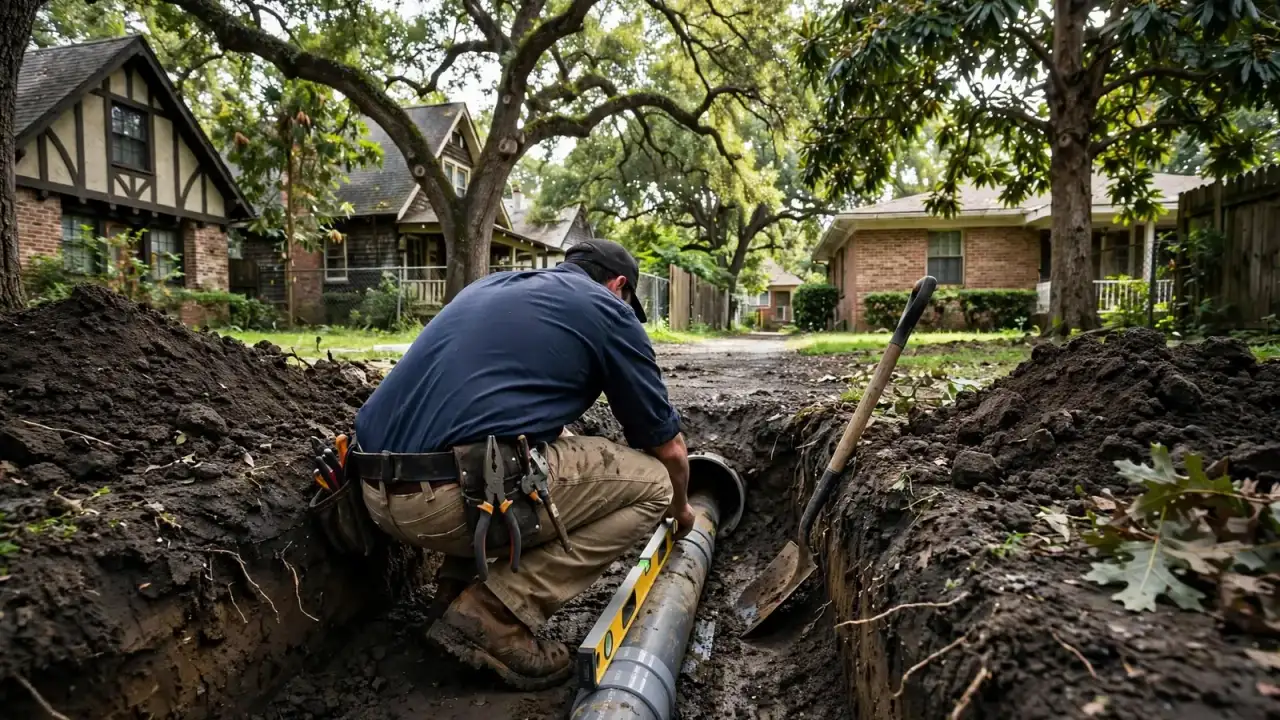
A gravity sewer depends on a steady downhill slope. Too flat, and solids settle and the line clogs. Too steep in short sections, and water outruns solids, leaving them behind. Plumbing codes set a minimum slope for building sewers, and the installer checks it along the trench with a level or laser before backfilling. On long Dallas laterals, keeping that slope consistent across changes in ground elevation takes care.
Bedding supports the pipe evenly. In clay soil that swells and shrinks, a bed of sand or fine gravel under and around the pipe spreads loads and reduces point stresses. Backfill is placed in layers and compacted so the pipe is not left hanging over voids. Skipping these steps is how new lines develop bellies within a few years.
Cleanouts on a new line
Cleanouts and access on a new Dallas sewer line
A new lateral is the right time to add proper cleanouts. A two-way cleanout near the house lets plumbers send a camera or cable in either direction: toward the house or toward the city. Codes require cleanouts at certain intervals and changes of direction. Good access makes every future service call faster, cleaner and less disruptive, and it lets you check the line yourself by removing a cap.
Connecting to the city lateral
The connection at the property line
At the far end, the new building sewer connects to the city's lateral near the property or easement line. That connection must be made with approved fittings and sealed properly. If the city's lateral is damaged or poorly aligned, the plumber will note it, and repairs on the public side are arranged with Dallas Water Utilities. A clean transition at the boundary prevents roots and soil from entering where old and new pipe meet.
Replacing lines under driveways and patios
Driveways, patios and pools over the sewer path
In many Dallas yards, the sewer runs beneath a driveway, patio or pool deck. Open-trench replacement through these surfaces means saw-cutting concrete, removing it and pouring new concrete after the pipe is installed. Pipe bursting or rerouting the new line around the hardscape can avoid that. The plumber weighs depth, path and the surfaces above when recommending a method.
Older lots and abandoned lines
Old septic systems and abandoned lines on older lots
Some Dallas neighborhoods were developed before city sewers reached them, and a few older lots still contain abandoned septic tanks or earlier lines. Replacement crews sometimes uncover them. Abandoned tanks must be handled safely, usually by pumping and filling or removing them, which may involve other permits. Ask the plumber how such finds would be handled.
Choosing a replacement contractor
Questions to ask before replacing a sewer line
Ask which method the plumber recommends and why, based on the camera video. Ask how they will handle slope, bedding and cleanouts, who pulls the Dallas permit, how long sewer service will be off and what restoration is included. Ask whether they will film the new line. Check their license with the Texas State Board of Plumbing Examiners and get the scope in writing. [5]
Replacement and foundation work
Coordinating sewer replacement with Dallas foundation repair
Foundation repair and sewer replacement often go together in Dallas. A failing lateral can saturate soil near the house and contribute to movement; leveling a foundation can stress drain lines. If both are planned, sequencing matters. Many plumbers and foundation contractors recommend testing and inspecting the plumbing before leveling, completing urgent sewer repairs, then leveling, then re-testing. Talk to both trades so neither undoes the other's work.
Replacing part of a line
Partial replacement versus the whole lateral
Sometimes only part of a line has failed, for example a corroded cast iron section near the house while the clay farther out is still sound, or the reverse. Replacing just the failed portion is reasonable when the rest of the line is genuinely healthy on camera. If the remaining pipe is old and showing early defects, replacing the whole run at once can avoid digging again in a few years. The camera video is the basis for that decision.
Replacement in Dallas neighborhoods
How replacement differs across Dallas neighborhoods
In Lakewood and the M Streets, replacements often involve alley-side laterals under detached garages and fences, with clay pipe from the 1920s and 1930s. In Kessler Park and other parts of North Oak Cliff, sloping lots and long front yards change depth and access. In Preston Hollow, large lots mean long laterals and big trees, which makes trenchless methods attractive. In Lake Highlands and Casa View, slab homes from the 1950s and 1960s often need both the exterior lateral and under-slab cast iron addressed. Each pattern shapes the plan.
What to expect on replacement day
A typical replacement day in a Dallas yard
On the day of an open-trench replacement, the crew arrives, confirms the 811 markings, lays tarps for spoil and protects walkways. Water to the house usually stays on, but you will be asked not to use drains once the old line is cut. Excavation proceeds from one end, the old pipe comes out in pieces, and the trench is shaped for bedding. New pipe is laid and checked for slope. The inspector visits when scheduled, and backfill follows. Expect noise, equipment in the yard and some mud if the ground is wet, especially after rain on Dallas clay.
Living without sewer service
Managing a day without drains
During replacement, drains are out of service while the old line is cut and the new one connected. Plan meals that need little cleanup, shower before work starts and avoid laundry that day. If the job runs longer, ask the plumber about temporary arrangements. Most Dallas laterals are reconnected within the same working day once the new pipe is in place and the inspector has signed off.
Replacement questions
Questions about sewer line replacement in Dallas
How do I know if my sewer line needs replacing instead of repairing?
A camera inspection decides it. Orangeburg pipe, many breaks, widespread bellies or badly corroded cast iron usually mean replacement. Isolated defects usually do not.
Do I need a permit to replace a sewer line in Dallas?
Generally yes. A licensed plumber pulls the city plumbing permit and schedules the inspection before backfilling.
Can a sewer line be replaced without digging up the whole yard?
Pipe bursting replaces the line through pits at each end. It does not fix bellies and needs a passable path.
Who is responsible for the sewer line from my house to the street?
Under Dallas code, the property owner's plumber installs and maintains the building sewer up to the city's lateral near the property line. The public side is the city's.
What pipe is used for new sewer lines?
Usually PVC for open trench and HDPE for pipe bursting. Both resist roots and corrosion.
Will replacing my sewer line stop root problems?
New jointless or solvent-welded pipe gives roots no easy way in. Roots may still grow near the pipe but cannot enter properly sealed joints.
Can I live in the house during replacement?
Usually yes, but sewer service will be off for part of the job. Plan ahead for that period.
Can a new sewer line be routed differently?
Yes. Rerouting around trees, pools or additions is sometimes better than following the old path. The new route must maintain slope and connect properly to the city lateral.
How deep will the trench be?
Depth depends on the existing line and the slope to the city connection, often a few feet near the house and deeper toward the main. The locator measures it before digging.
What happens if the trench settles later?
Some settling is normal in clay. Topping up soil and reseeding fixes it. Large settling should be reported to the contractor.