Key facts: Root Intrusion Removal
- Tree roots grow toward moisture and nutrients, which is why they enter sewer pipes through cracks and joints [1].
- Vitrified clay pipe, common in older Dallas homes, was laid in short sections with many joints that roots can penetrate [2].
- Cured-in-place pipe lining creates a jointless pipe inside the old one, removing the gaps roots use to enter [3].
- Plumbers in Texas must be licensed by the Texas State Board of Plumbing Examiners [4].
How root removal works
How plumbers remove roots from a sewer line
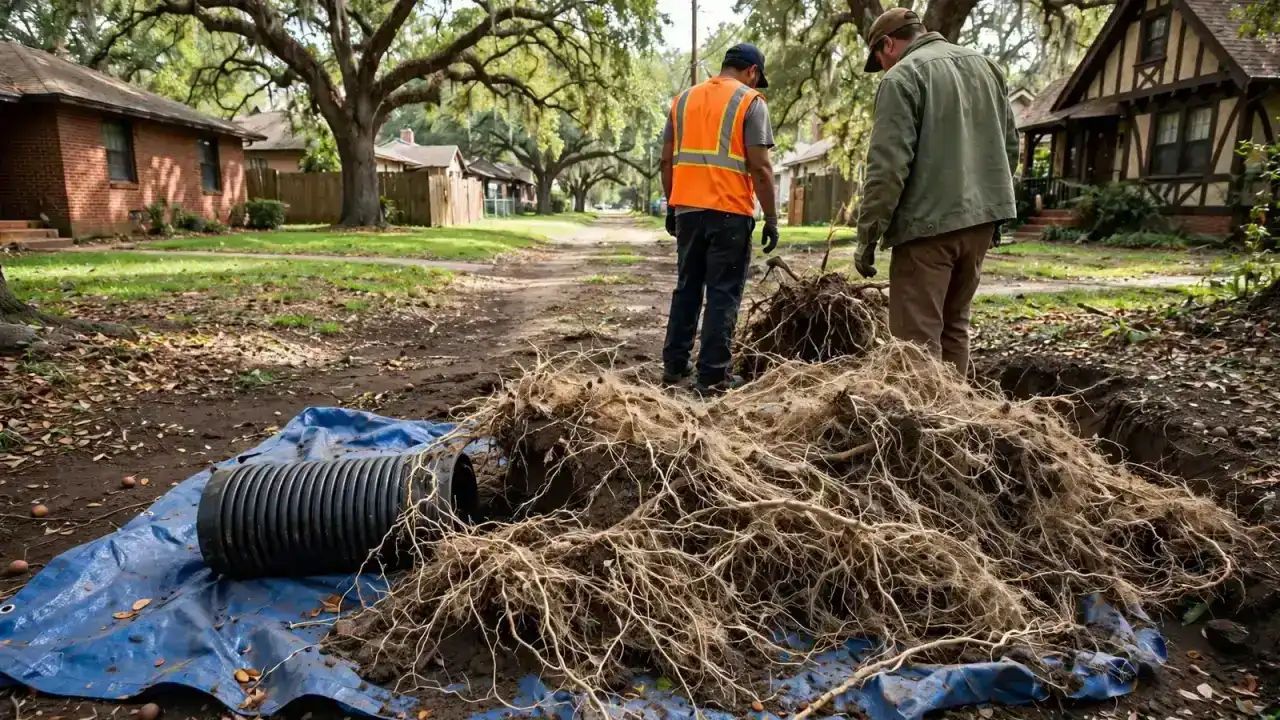
Root removal starts with access, usually an outdoor cleanout. The plumber runs a sewer machine with a cutting head on a rotating cable, which chews through roots as it advances. Different heads suit different jobs: spiral cutters for fine roots, saw-tooth blades for dense mats. The cable is run to the city connection or until the line flows freely.
Hydro jetting is another option. A high-pressure water jet with a rotating nozzle scours the pipe walls and cuts roots, flushing debris downstream. Jetting cleans more thoroughly than cabling in many lines, but it must be used carefully on fragile pipe, because strong water pressure can worsen cracks in old clay or Orangeburg.
After cutting, a camera inspection shows how much root remains, where the roots entered and the condition of the pipe. That video determines the next step: maintenance, root control treatment or a permanent fix that seals the entry points.
Root warning signs
Signs tree roots are in your Dallas sewer line
Roots usually announce themselves gradually.
Slow drains throughout the house
Roots narrow the pipe over months, so drains slow before they stop.
Read moreGurgling toilets
Restricted flow pushes air back through fixtures.
Read moreBackups after heavy use
Laundry days or guests can overwhelm a root-narrowed line.
Read moreRecurring clogs every few months
Roots grow back after cabling.
Large trees near the line
Live oaks, pecans, elms and hackberries within reach of the sewer path.
Lush patches in the lawn
Leaking sewage can fertilize grass over the line.
Read more
Roots figure
Why roots get in
Why roots invade Dallas sewer lines
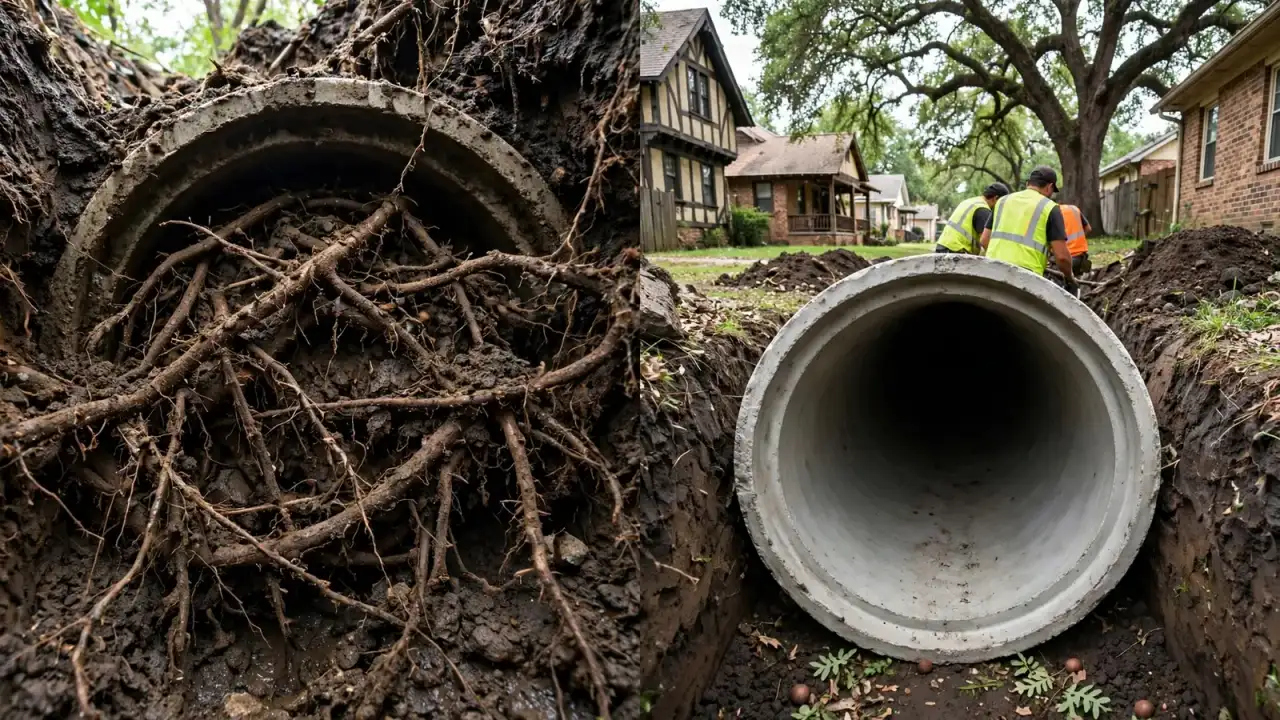
Roots do not break intact pipes by force. They find openings: loose joints in clay pipe, cracks, gaps between offset sections and failed connections. Warm, moist air and water seeping from those openings draw fine roots toward them. Once inside, roots find water and nutrients and grow rapidly, forming dense masses.
Dallas conditions encourage this. Long hot summers and periodic droughts send roots searching for water, and a leaking sewer line offers a steady supply. The expansive clay opens joints as it shrinks and swells, creating new entry points. Older neighborhoods with mature trees and clay laterals see roots most often.
Some trees are more aggressive than others, but any large tree near the line can contribute. Removing a tree rarely solves the problem quickly, because existing roots remain and the pipe stays damaged.
Root removal steps
How a root intrusion job is done
- 1
Find access
The plumber opens a cleanout or arranges access through a vent or toilet.
- 2
Cut or jet
Roots are cut with a cable machine or scoured with a water jet.
- 3
Flush
Debris is flushed downstream to the city main.
- 4
Inspect
A camera shows remaining roots and entry points.
- 5
Locate
Entry points are marked on the ground with a locator.
- 6
Recommend
The plumber explains maintenance, treatment or permanent repair options.
Root removal methods
Root removal methods compared
| Method | What it does | Limits |
|---|---|---|
| Cable cutting | Cuts a path through roots | Leaves root stubs; regrowth expected |
| Hydro jetting | Scours walls and cuts roots | Must be used carefully on fragile pipe |
| Chemical root control | Kills roots inside the pipe | Temporary; follow label directions |
| Spot repair | Replaces a section where roots enter | Fixes one entry point only |
| Lining | Seals the whole line | Requires intact, round pipe |
| Replacement | New jointless pipe | Most disruptive |
What you can do yourself
Homeowner steps for root problems
These steps help, though they do not replace professional cleaning.
- Note when drains slow and which fixtures are affected.
- Avoid flushing wipes, paper towels and grease, which catch on roots.
- Find your cleanout and keep it accessible.
- Note large trees near the line.
- Do not pour copper sulfate or other products without reading label directions and local rules.
- Plan permanent repair if cleaning is needed more than once a year.
Where to stop
When root removal needs a professional
Rental augers can clear a small clog but rarely cut a root mass in a main line, and they can get stuck. Hydro jetting equipment can be dangerous without training. A professional also brings the camera to confirm the result. If sewage is backing up, call a plumber rather than attempting removal yourself.
Root intrusion removal in Dallas: local specifics
Dallas trees and sewer roots
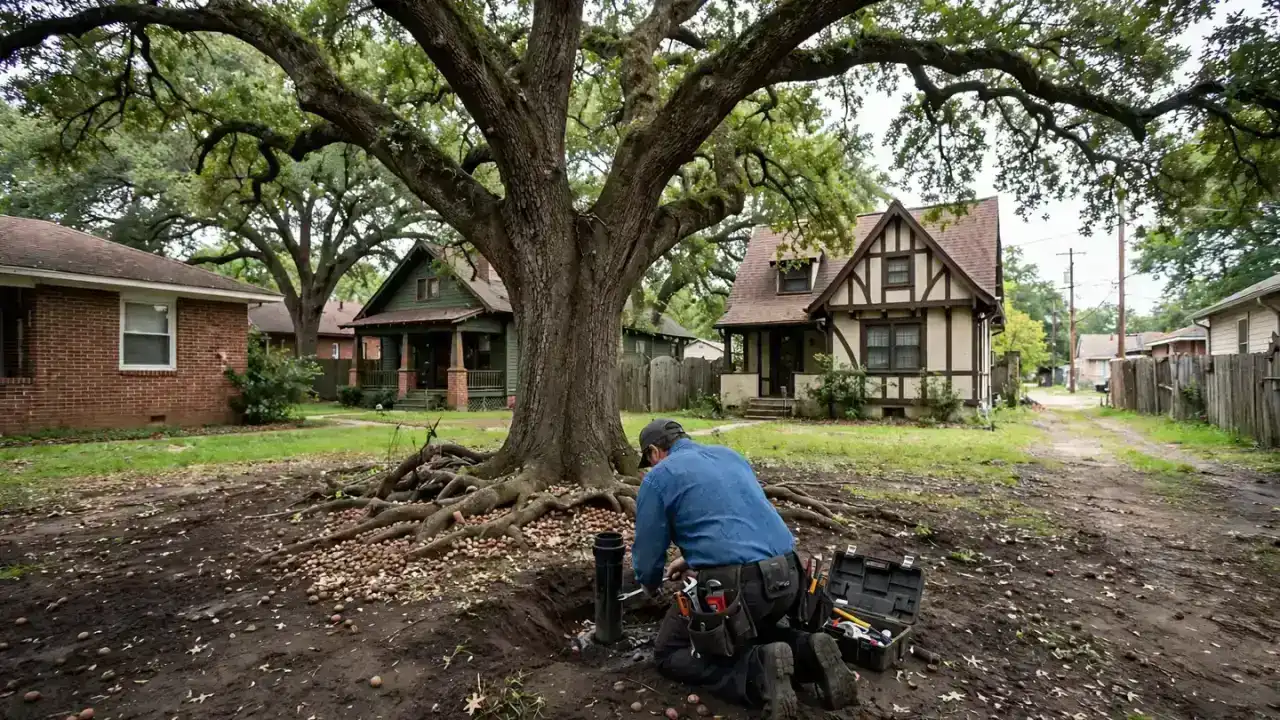
Dallas's older neighborhoods are known for their tree canopy. Lakewood, Kessler Park, Preston Hollow, the M Streets and much of East Dallas have mature live oaks, pecans, cedar elms and hackberries that were planted when the houses were built or grew up since. Many of those trees stand within reach of sewer laterals, especially where the line runs under the front yard or along the side of the house to an alley.
The expansive clay plays a part too. As it shrinks in drought, cracks open around pipes and joints separate, giving roots new entry points. After rain, the clay swells and squeezes pipe. Combined with aging clay and cast iron, these conditions make roots one of the most common causes of backups in the city.
Permits apply to the repair work that follows cleaning. Root cutting is maintenance, but spot repairs and replacement generally require a city plumbing permit.
Clean, line or replace
Deciding what to do about recurring roots
| Camera finding | Reasonable next step |
|---|---|
| Light roots at one joint, sound pipe | Periodic cleaning or spot repair |
| Roots at many joints, round pipe | Lining |
| Roots plus cracks and offsets | Lining or replacement |
| Roots plus bellies | Excavate bellies; line or replace the rest |
| Roots in collapsed or Orangeburg pipe | Replacement |
Related problems
Problems that come with root intrusion
Roots often mask other defects. Once cut out, the camera may reveal cracks, offsets or bellies that roots were filling. Backups caused by roots can damage floors and drywall inside. Roots may also invade irrigation lines and storm drains. Treat the sewer issue as part of a broader look at the yard.
Trees and sewer lines
Living with big trees and a healthy sewer line
Most Dallas homeowners do not want to lose their trees. The good news is that a sealed sewer line and a healthy tree can coexist. Lining or replacing the line removes the joints and cracks roots use, so the tree's roots stay outside the pipe. When planting new trees, keep them away from the sewer path and choose species suited to the space.
Root control treatments
Chemical root control in sewer lines
Some plumbers offer root control treatments, products applied inside the pipe to kill roots and slow regrowth. They can extend the time between cleanings but do not fix the openings roots use. They must be applied according to label directions. Ask the plumber what product they recommend and how often.
Maintenance schedules
Scheduled root cleaning for Dallas homes
For homeowners not ready for lining or replacement, scheduled cleaning can keep roots under control. Many choose to clean the line once or twice a year before backups occur. A camera check every so often confirms the pipe is not getting worse. Over time, the inconvenience of repeated cleaning often leads owners to a permanent fix.
Roots and older clay laterals
Roots in Dallas clay laterals from the 1920s to 1950s
Clay laterals were laid in sections a few feet long, each joint a potential entry point. In older Dallas neighborhoods, many of those joints have opened. Roots enter at regular intervals, which the camera shows as repeating root masses every few feet. Lining is often the most effective fix for this pattern.
Jetting versus cabling
Choosing between cable cutting and hydro jetting
Cable machines are the traditional tool for roots. A spinning cutter on a steel cable bores through the root mass and opens a path. It is effective and quick, but it leaves roots attached to the pipe walls and stubs at the joints, which regrow. Hydro jetting uses high-pressure water through a nozzle that sprays backward and sideways, scouring the full circumference of the pipe. Specialized root-cutting nozzles add rotating blades.
Jetting often leaves a cleaner pipe and flushes debris thoroughly, but the pressure that cleans well can also open cracks in fragile pipe. Many plumbers cable first to open the line, then film it, then decide whether jetting is safe. On sound pipe, jetting gives longer intervals before roots return.
Roots and foundations
Roots, sewer leaks and Dallas foundations
In Dallas, sewer leaks and roots can affect foundations. Water leaking from a cracked lateral near the house saturates the clay, which swells unevenly under one part of the foundation. Tree roots, drawn by that water, grow toward the house and later dry the soil in other areas. Both effects can contribute to foundation movement. Fixing the sewer leak removes one source of uneven moisture. If foundation movement is a concern, a foundation professional can assess the structure separately.
Roots after cleaning
What to expect after roots are removed
Right after cleaning, drains run freely. Over the following months, roots usually begin to grow back from the same joints. How fast depends on the tree, the season and how large the openings are. In summer, when trees search hardest for water, regrowth can be quicker. If backups return within a few months, that is a strong signal to discuss lining or replacement rather than more cleaning.
Roots in under-slab drains
Roots under the house
Roots sometimes reach drains beneath slabs or in crawlspaces, especially where trees grow close to the house. These intrusions are harder to reach and repair. A camera inspection from an interior cleanout or toilet shows how far roots have traveled. Repair may involve lining from inside, rerouting or tunneling, depending on access.
Root removal and the city
When roots are on the city's side
Sometimes the camera shows roots at or beyond the connection to the city's lateral, from a street tree or parkway tree. Problems on the public side are the city's to address. The plumber can show you the video and footage so you can report it to Dallas Water Utilities through 311.
Choosing a root removal service
Questions to ask about root removal
Ask whether the plumber will run a camera after cleaning and provide the video, which equipment they plan to use and why, and what they recommend if roots are found at many joints. Ask whether the line's condition is safe for jetting. Check the plumber's Texas license.
Seasonal root activity
When roots cause the most trouble in Dallas
Root growth follows the seasons. In spring, trees put out new roots quickly. In the long, dry Dallas summer, roots search hardest for water, and a leaking sewer line is an easy target. That is why many root backups happen in late summer and early fall. Scheduling cleaning in late spring, before the hottest months, can prevent summer backups for lines that need regular maintenance.
Sizing up the tree
How tree size and distance affect sewer roots
Root systems of mature trees can extend well beyond the canopy, so a tree on the far side of the yard can still reach a lateral. Species matters less than distance and moisture: any large tree within reach of a leaking pipe can invade it. When planning landscaping, keep new trees well away from the sewer path, and favor species whose mature size fits the space.
Documenting root problems
Keeping records of root cleaning
Keep a simple log of when the line was cleaned, what equipment was used and what the camera showed. Over time, it reveals how quickly roots return and helps decide when a permanent fix is worth it. It is also useful information for buyers if you sell the house.
Roots and older Dallas neighborhoods
Neighborhoods where roots are most common
Roots are most common where three things meet: older clay or cast iron laterals, mature trees and expansive clay. In Dallas, that describes much of East Dallas, Lakewood, the M Streets, Kessler Park, Winnetka Heights and other neighborhoods developed before the 1960s. Newer neighborhoods with PVC laterals see fewer root problems, though roots can still enter at damaged sections or poorly sealed connections.
Root removal before lining
Preparing a root-filled line for lining
Before a liner can be installed, the pipe must be completely clear. Crews cut roots flush with the pipe wall, often with specialized cutters, and jet out debris. Any protruding root stubs or heavy scale would create bumps in the liner. A camera pass confirms the pipe is ready. This preparation step is a big part of a successful lining job in root-damaged Dallas laterals.
Roots and irrigation
Sprinkler systems, moisture and sewer roots
Lawn irrigation keeps soil moist around shallow roots, which can encourage root growth near sewer lines. Leaking irrigation lines add more water. Checking sprinklers for leaks and avoiding overwatering near the sewer path reduces the moisture that draws roots. It will not stop roots from entering a cracked pipe, but it helps.
Signs roots are returning
Early signs that roots are growing back
After cleaning, watch for the same signals that appeared before: drains that slow gradually, gurgling in a toilet when another fixture drains, or the lowest drain backing up during laundry. These usually start weeks or months before a full blockage. Calling at the first sign, rather than waiting for a backup, keeps the cleanup simple and limits damage inside the house.
Roots and property lines
Roots from a neighbor's tree
Roots do not respect property lines. A neighbor's tree, or a tree in the alley or parkway, can be the source. The repair responsibility still follows the pipe: you maintain your building sewer regardless of whose tree the roots came from. Talking with neighbors about tree locations can help when planning repairs or new plantings.
Root intrusion and home sales
Roots found during a Dallas home sale
Buyers increasingly order sewer camera inspections on older Dallas homes. Roots found during a sale may become part of negotiations. Sellers who know their line has roots can choose to clean and document it, line it, or disclose it. Buyers can use the video to plan repairs after closing. Either way, a clear video helps everyone understand the condition.
After a permanent fix
Root-proofing for the long term
Once a line is lined or replaced, roots have no joints to enter along the new pipe. The remaining risk is at connections to the house drain and the city lateral, which should be sealed with approved fittings. A camera check a year or two after the work confirms everything is holding, especially in yards with large trees close to the line.
Root removal questions
Questions about root removal in Dallas
How do I know if tree roots are in my sewer line?
Slow drains, gurgling and repeated backups are common signs. A camera inspection confirms roots and shows where they enter.
Will roots grow back after cutting?
Usually yes, because the entry points remain. Lining or replacing the pipe stops regrowth.
Is hydro jetting safe for old pipes?
It can be when used properly, but fragile clay or Orangeburg pipe may be damaged. A camera inspection first helps decide.
Should I remove the tree causing the problem?
Not necessarily. Sealing the pipe usually solves the problem while keeping the tree. Removing a tree leaves roots and a damaged pipe behind.
How often should roots be cleared?
It depends on the line. Some need cleaning yearly; others more often. Frequent cleaning is a sign a permanent fix is worth considering.
Do root killers work?
They can slow regrowth when used according to label directions, but they do not seal the openings roots use.
Which trees cause the most sewer problems in Dallas?
Any large tree near the line can, including live oaks, pecans, elms and hackberries common in older neighborhoods.
What should I tell the plumber about a root problem?
How often drains slow or back up, where large trees stand, the age of the house and any past cleaning or camera videos.
Can roots damage my foundation?
Roots themselves rarely damage foundations directly, but they change soil moisture, and sewer leaks that attract them can saturate clay unevenly. Fixing the leak helps.
Are some pipes more root-resistant than others?
Yes. Solvent-welded PVC and fused HDPE have no open joints along their length, so roots have far fewer ways in than with old clay or cast iron.
Can I do anything to slow root regrowth?
Avoid flushing wipes and grease, which catch on roots, and consider scheduled cleaning before the summer peak. Only sealing the pipe stops regrowth.
Will lining stop roots for good?
A properly installed liner has no joints along its length for roots to enter. The connections at each end must be sealed well.
Does root removal need a permit?
Cleaning does not, but repairs or replacement that follow generally do.